
When we take example of Company’s like Nokia it’s become Stuck after a couple of years. This problems teach us motivation and capability are not really the problem in majority of the case. The problem is vague or poor business idea or wrong business concepts.
The central point of your business is a business concept. It tells how you do what, to whom you do it, how you create value and how you make money. At this point, it is easy to make decisions. Even good efforts give bad results when it is unclear.
In my experience of working closely with owners of business, I can easily say that businesses do not fail overnight. When they are not identifying, revising, or updating their business idea with time, they lose focus gradually.
The following is a list of 11 practical business concepts with explanations in a simple and realistic manner that every business owner must be familiar with and implement.
1. Problem Solving Approch
When business is starts it address an issue. The better the problem and the more clear it is, the better the business. Customers do not purchase products and services. They purchase reprieve of pain, stress, delay, confusion or loss.
What I observe is that a major pitfall that most businesses commit is the overemphasis on features and underemphasis on problems. Failure to articulate the problem you are solving will make it difficult to customers to comprehend why they have to use you.Successful companies remain near customer areas of pain and develop solutions on them.
The most appropriate question to pose on a regular basis is the following one:
Ask Yourself
What problem does my customer have in their lives before they see me, and how does their life become better after they see me?
2. Value Proposition
Value proposition is a response to one question is Why should a customer select you over the rest? This is not concerned with being less expensive. It is of being more relevant and clear. The saving of time, minimizing effort, minimizing risk, enhancing quality, or heightened support can be a source of value.
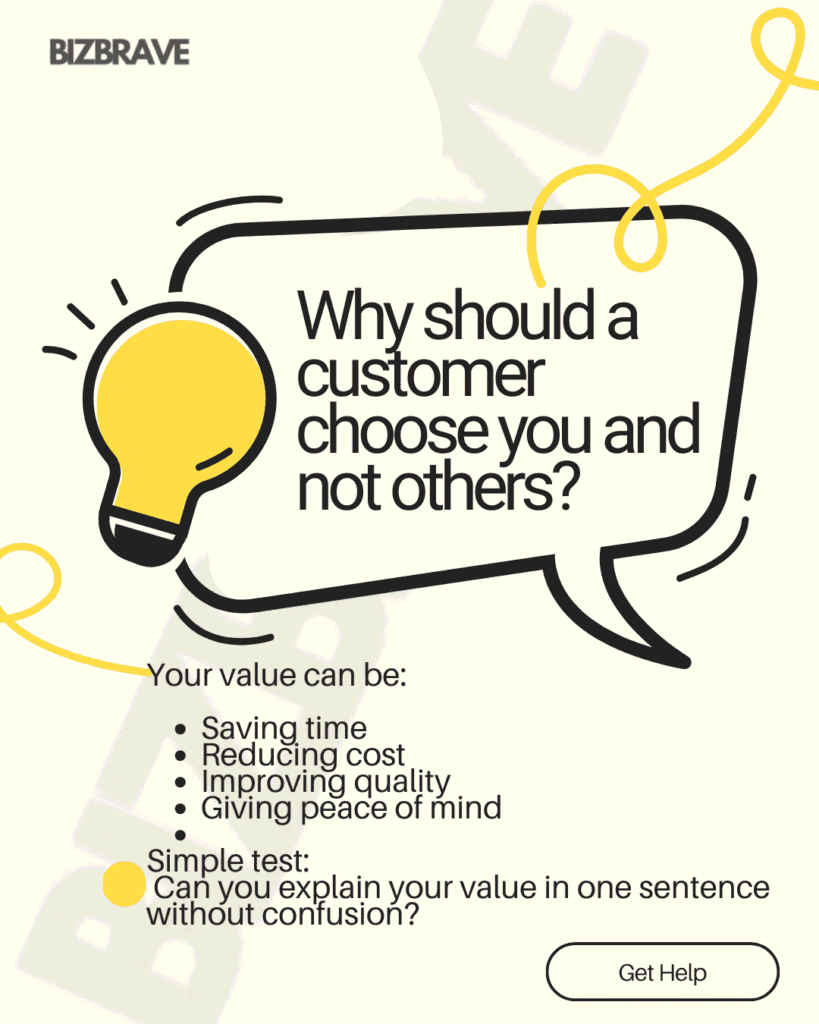
A strong value proposition means that customers will not bargain with you since they realize there are benefits. Personally, whenever your value proposition cannot be summarized in a single line, then it requires improvement.Trust is constructed as a result of simplicity, and sales are made with trust
3. Target Customer
Attempting to please everybody is one of the largest growth killers. A clear target customer is characterised by a clear business concept. This involves their industry, size, level of budget and style of decision-making.
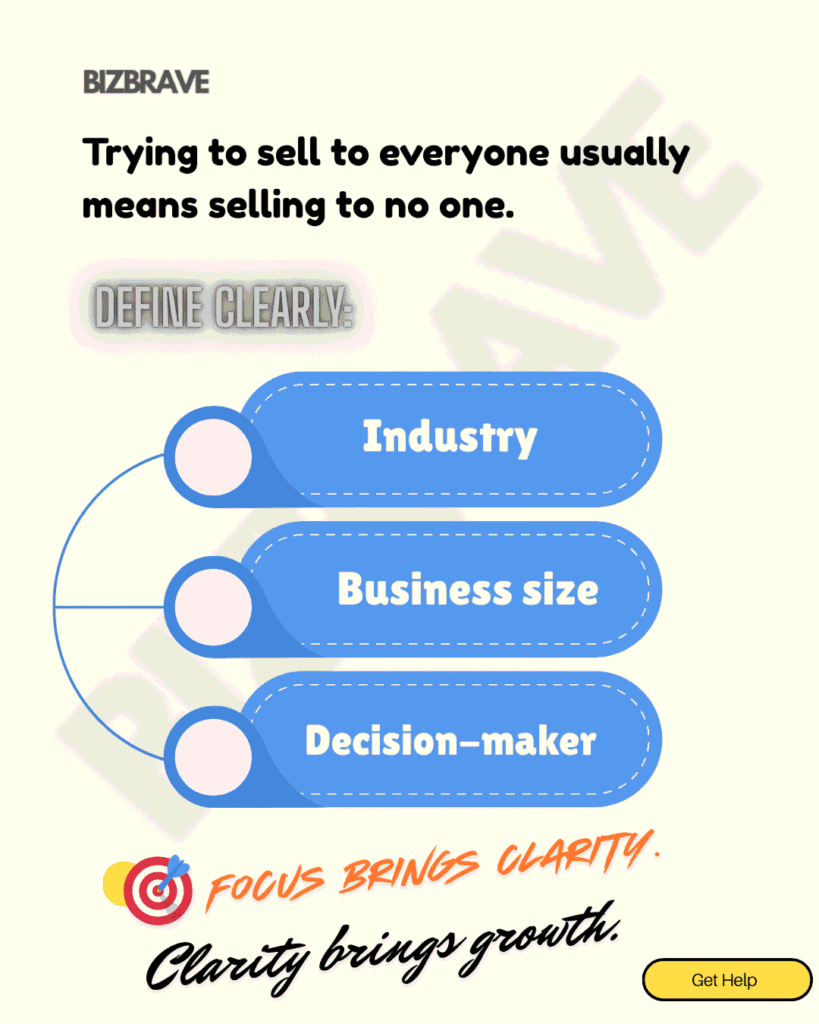
This is because when you know perfectly who your perfect customer is, your marketing will be targeted and focused, communication will be better and your product or service will be more efficient.
More growth is achieved when your message seems personal to the right audience. Powerful companies do not pursue clients.They are specific when attracting the right ones.
4. Revenue Model
Several of the businesses survived so hard yet find themselves in great financial difficulties due to poor revenue model.Revenue model describes the flow in of cash into your by business and the predictability of that flow. Single sale will bring short term revenue, whereas recurring revenue will be stable.
Retainer system, subscriptions, annual term and repeat purchase systems assist businesses to plan better and to grow with confidence. In the long term, companies that can predict their income rest easier and make decisions that are wiser.
5. Cost Structure
The question of revenue is not the end, profitability depends on cost control. Good business idea involves having a good knowledge of fixed costs, variable costs, and unnecessary expenses. Numerous businesses that are expanding do not pay attention to costs.
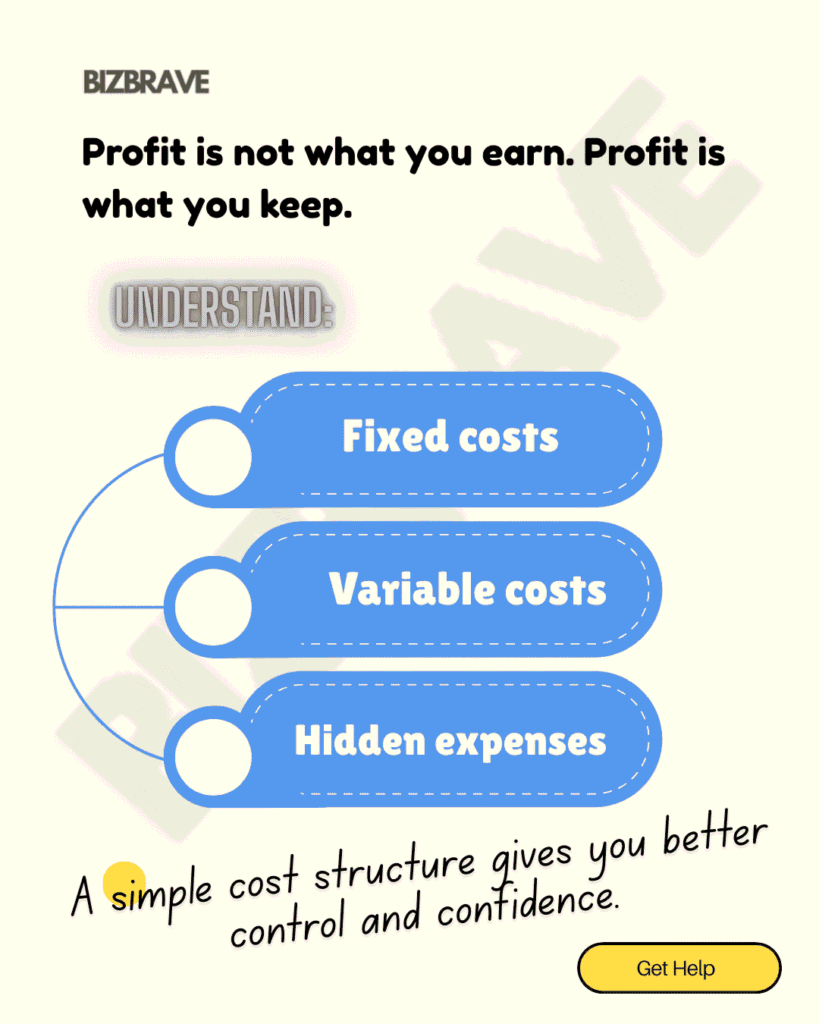
Minor leakages gradually become major losses.When you have an idea of where you spend your money, it makes you take control. In cases where you do not, there is an added stress.
Profitability is not concerned with reducing everything. It involves spending time consciously.
6. Competitive Advantage.
There is competition in any market. It is not whether there are competitors or not, but it is whether you are markedly different in a material sense. Your competitive edge may be trust, speed, experience, service quality, niche focus or operational efficiency. It is not necessary that it is dramatic.
Practically, companies with clearly stated advantage will find it easier to attract good customers as well as deal with under price pressure.
7. Scalability
A business that develops at the expense of increasing workload of the owner is not a growing business. Scalability implies that the business will be able to expand without requiring corresponding increments in the amount of stress, time, and reliance on an individual. Scalable enterprises are dependent on systems, documentation, automation, and trained workforces. The growth must make you freer and not diminish it. A good business idea would always look at the way growth will be managed even before the growth takes place.
8. Process and System
The processes form the main foundation of stability. Businesses operate without systems relying on memory, people, and day-to-day firefighting. This brings disparity and exhaustion. Sales, operations, inventory, customer support, and finance have clear processes and decrease errors and enhance customer experience. Systems enable business to provide quality on the same level all the time.
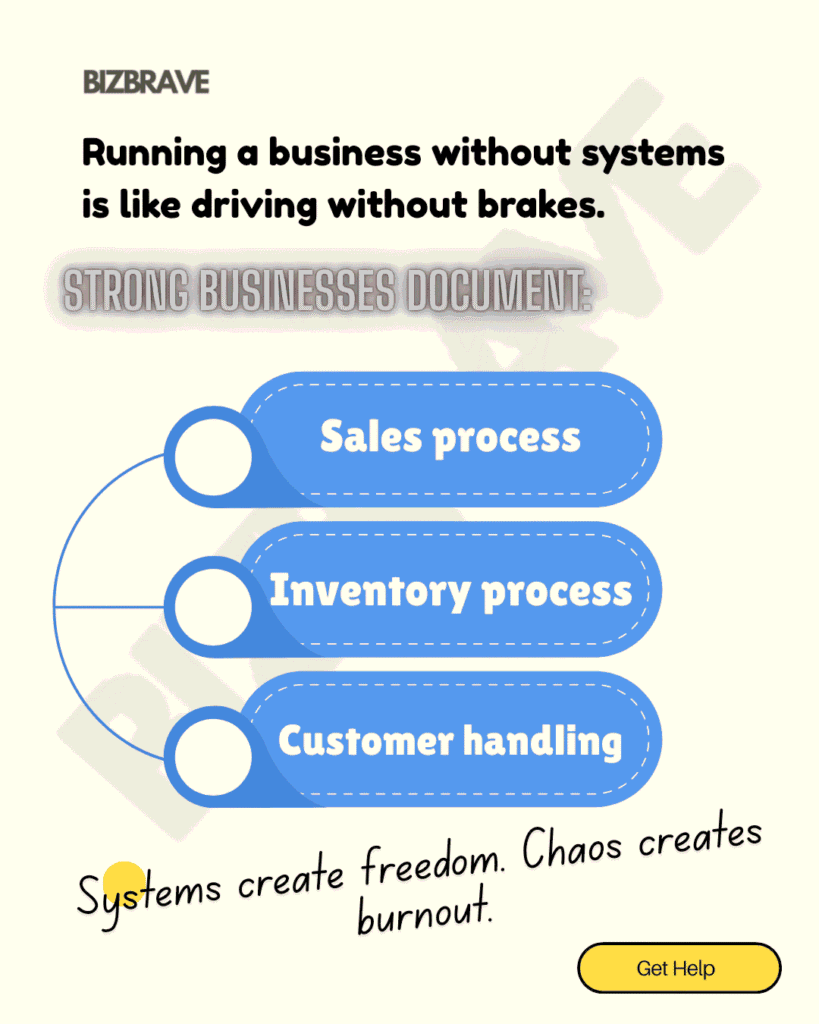
Through experience, I can say this with a lot of certainty: systems do not inhibit creativity. They protect it.
9. Customer Experience Idea.
Customers will never remember the things that you have said, but they will always remember the way that your business made them feel. Customer experience is associated with all the interactions, including initial contact to the aftersales service. Long term relationships are developed through simple communication, timely response, clear pricing and dependability of delivery. Discounts do not make loyal customers. They are formed through the trust and care. Customer experience is not something that is given second consideration in a strong business concept.
10. Digital Enablement
Digital tools have ceased to be an option in the business world of today. They assist the businesses in working efficiently, making sound decisions and expanding easily. Customer management systems, inventory systems, accounting and reporting systems save on manual work and errors. Your team should not be distracted by technology. Intelligent companies apply online solutions to streamline the processes and enhance visibility in businesses.
11. Long-Term Vision
The profit without the long-term perspective is confused as short-term profit. Looking through the future helps in decision making, alignment of the team and brand building. Having a clue of where you want your business to be within three and five years will aid you say no to any distractions and yes to the right opportunities. Sight generates concentration, endurance and patience. Visionary businesses are also less likely to be impacted by difficulties since they understand the path they are heading to.

Final Thoughts
A business idea is not a singular activity. It is an organic structure that should change as market, customer expectations and business maturity change. Examining your business idea periodically can make you relevant and competitive. When you get stagnant in your business, don’t switch products or get additional employees at once. To begin with, re-examine your business idea.
Clarity, more often than effort, is the best result-producer. Successful companies are not created accidentally. They are constructed through clear thinking, unwavering execution and customer oriented ideas.When you build a strong base, then development is a by-product. You can continue the discussion in case you are not sure or you want to talk about what concept your business should have the most at the moment. The right conversation will make growth begin.