
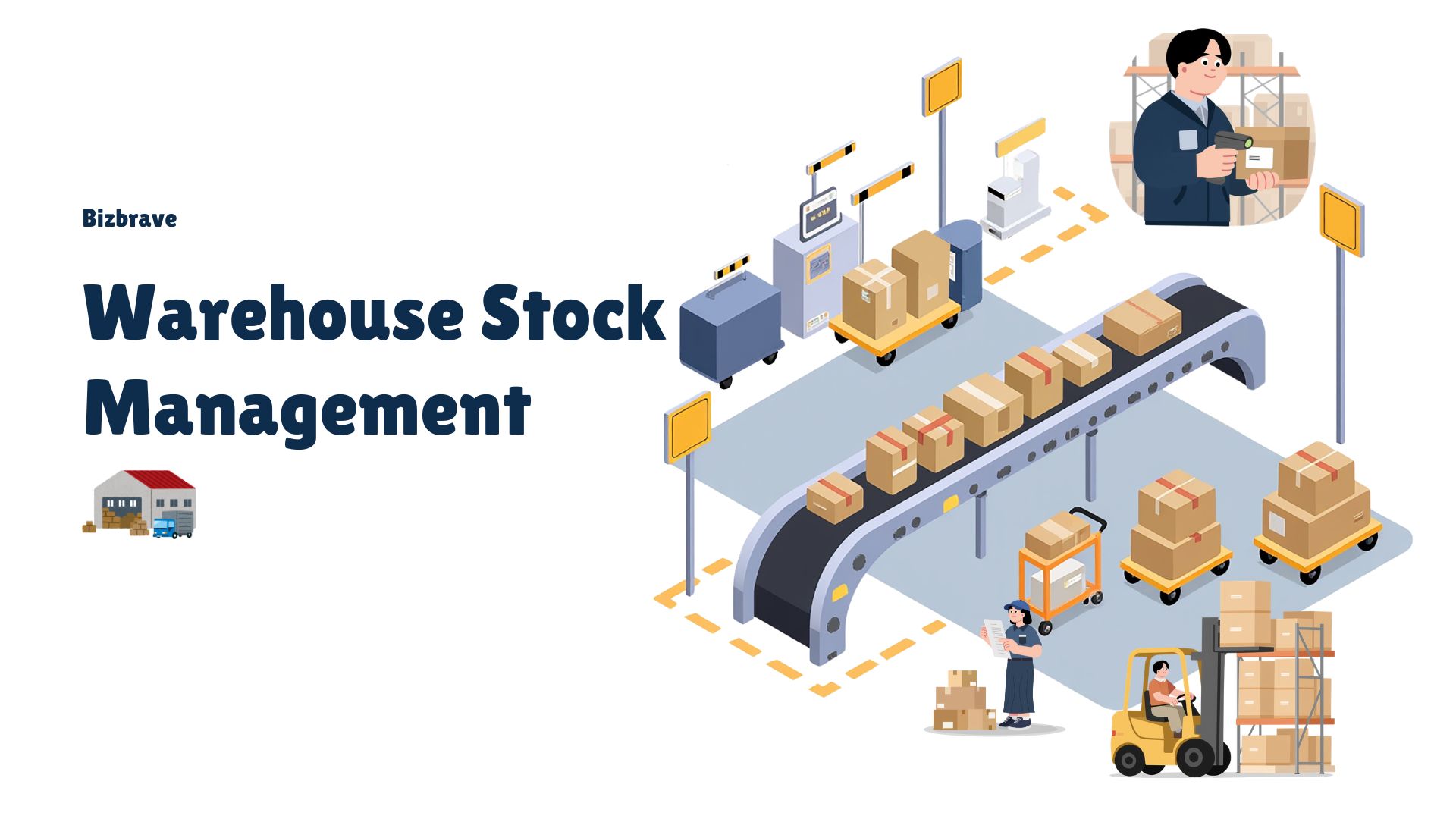
Warehouse Stock Management is no longer a matter of keeping things locked up but a matter of managing cash flow and making customers happy, and creating a business that can scale up. Most expanding businesses do not face the problem of low sales, but due to poor visibility of stocks, overstocking or delayed deliveries.
In case you have ever experienced stock mismatch, late deliveries, or dead inventory, the following guide will assist you in rectifying the underlying causes and creating a system that will enable it to grow in the long run.
Warehouse Stock Management What is it?
The process of monitoring, managing and optimizing inventory in a warehouse is known as warehouse stock management. It involves all the processes of goods reception, storage, movement tracking and timely delivery. Essentially, it answers three business questions that are critical:
How much stock have I?
In what position?
At what point should I re-order?
When such answers are well defined, businesses run well.
Failing which, everything falls out of control, orders are missed, customers remain dissatisfied and money is lost. The importance of Warehouse Stock Management to Business Growth.
Majority of businesses believe that inventory is an operation. As a matter of fact, it is a strategic role. Inadequate stock management causes: Obstructed working capital as a result of overstocking. Lost sales due to stockouts Increased operational costs Poor customer experience Conversely, a good Warehouse Stock Management assists you in: Improve order accuracy Reduce holding costs Reduce delivery time. Establish customer and dealer trust.
Important Warehouse Stock Management Components.
1. Inventory Tracking
This is based on real-time monitoring of inventory.
Spreadsheets fail to manage scale and complexity and hence businesses are shifting to digital processes as opposed to manual tracking.
Practical Tip: Tracking based on barcodes or QR codes helps to exclude human error and increase the velocity.
2. Stock Organization
Unarranged warehouse wastes more time in picking, more mistakes and frustration. Intelligent businesses plan inventories on the basis of: Fast-moving vs slow-moving items Product categories Demand frequency
Practical Tip: Move the products of high demand nearer to dispatch points to minimize transportation time.
3. Receiving and Putaway Process.
This step is disregarded by many businesses, and mistakes during the receiving process cause problems in the long run.
The presence of a good receiving system guarantees: Correct quantity verification, Quality checks, Correct tagging and locations.
Practical Tip: Design a receiving system by use of the checklist to prevent entry level errors.
4. Picking and Packing of Orders.
Whether your picking is slow or not accurate, it directly influences customer satisfaction. Popular picking techniques are:
Batch picking
Zone picking
Wave picking
5. Inventory Replenishment
One of the quickest methods of losing customers is by going out of stock.
An intelligent replenishment system will guarantee: Stock levels are kept to minimum. Automatic reorder alerts Demand-based forecasting
Practical Tip: Based on previous sales data, anticipate demand in the future rather than make assumptions.
Typically, Warehouse Stock Management is faced with these challenges.
With an increasing number of businesses come the complexities of warehouses- and here is where most of the problems start. Lack of real time visibility is one of the biggest challenges. It is common to experience stockouts or over-ordering due to inaccurate and outdated information when making decisions, which are postponed or made on assumptions.
In combination with this, physical and recorded inventory often have mismatches due to errors made by hand when counting, entering data, and dispatching. The other problem that is prevalent is overstocking that quietly ties up working capital and raises storage expenses and leaves dead stock that does not move.
Another productivity killer that is not obvious is Inefficient warehouse layout. The failure to arrange products in a strategic manner means that the teams will waste time in searching than performing their work, slowing down the operations and raising labor expenses. Finally, there are numerous businesses that lack standard processes.
In the absence of well-defined SOPs, operations are largely dependent on people and not systems and thus, consistency and scalability are challenging.
Best Practices In Effective Stock Management in the Warehouse.
Effective warehouse management is founded upon data, rather than guesses. Organisations that are always successful keep vital measurements such as inventory turnover ratio, accuracy of order rate, and stock ageing. These learnings aid in making informed and timely decisions, minimize waste and enhance efficiency.
The other potent method is introducing ABC analysis. All products do not have to be handled the same way, high-value products must be put on a shorter leash, whereas low-value, high-volume products can be handled differently. Such prioritization assists in the effective allocation of resources and enhances the overall control. The optimization of warehouse layout is also important.
Movement and demand Designing your warehouse on movement and demand with fast-moving products in easy access, heavy products on lower shelves, and frequently picked products being close to dispatch can reduce handling time and this would increase speed.
Establishing explicit workflows in receiving, storage, picking and dispatch is a way to be consistent and minimize reliance on individual persons. This develops over time to create a more reliable and scalable operation. In this whole process, technology is a powerful facilitator.
A Warehouse Management System (WMS) enables companies to monitor inventory on-the-fly, automate their operations, minimize mistakes, and generate actionable reports. It changes the reactive mode of operations in the warehouse to proactive.
The use of Technology in the contemporary management of warehouses.
Companies integrating their warehouse systems with ERP and CRM programs have a big edge. They are able to monitor the patterns of customer demand, be able to plan inventory more efficiently, build a better dealer supply chain and decrease operational friction. Such a high degree of synchronization assists companies in accelerating and making a better decision.
The way that the Warehouse Management supports Dealer and Distributor Networks.
Warehouse efficiency forms a growing base to businesses that seek to increase their dealer or distributor base. Dealers want their goods to be delivered on time, receive the correct order, and have the product in stock all the time. Trust and relationships can be harmed by even minor mistakes in these aspects.
An efficient warehouse system will guarantee that multiple points of sale can be served effectively at the same time with consistency of stock across the regions. It minimizes the delays in delivery and enhances the reliability of fulfilling orders. Backend operation can be confined with the stability and therefore businesses are assured to expand their distribution network and establish long-term relationships.
Basic Warehouse Improvement Plan (Actionable).
It does not take huge investment to make the operations of the warehouse better, it takes understanding and uniformity. After becoming visible, see what products are moving at high rates and rearrange storage in order to focus on them.
Implement a simple tracking solution- even a basic digital solution can greatly enhance control. Standardization of key processes in such a way that operations can be repeated and are consistent. Lastly, it is advised to embrace technology slowly beginning with inventory management and then increase as your business expands.
The Metrics that you should monitor.
What is measured, is improved. Organisations monitoring the appropriate metrics have control over their business. Inventory turnover is used to determine the ease of stock movement and order fulfillment time is used to determine speed of operation. The accuracy of picking guarantees customer satisfaction and the discrepancy rate of stocks illuminates the gap in the process.
The metrics serve as a dashboard to decision making, to help you track down issues at an early stage and correct an issue before it affects business performance.
Prospects of Warehouse Stock Management.
Speed, accuracy and intelligence are the forces that drive the future of warehouse management. Manual dependency is being eliminated with automation and robotics, and AI-based demand forecasting is assisting businesses to become more precise in their forecasts. Cloud solutions are facilitating real-time capability to go anywhere, and analytics are offering deeper business insights.
Although adoption may not go as far as full adoption, being mindful of these trends will enable the businesses to be strategic in its planning and be competitive.
Final Thoughts
Stock management in warehouses is no longer merely an operation requirement, but rather a driver of growth. Effective inventory management leads to increased cash flow, increased customer trust and expansion in businesses. Most businesses are very keen on boosting sales yet overlook behind the scenes inefficiencies that ultimately hinder growth.
It is more prudent to establish a good operational base first. Your processes should be reliable, which makes it easier and more sustainable to scale.